
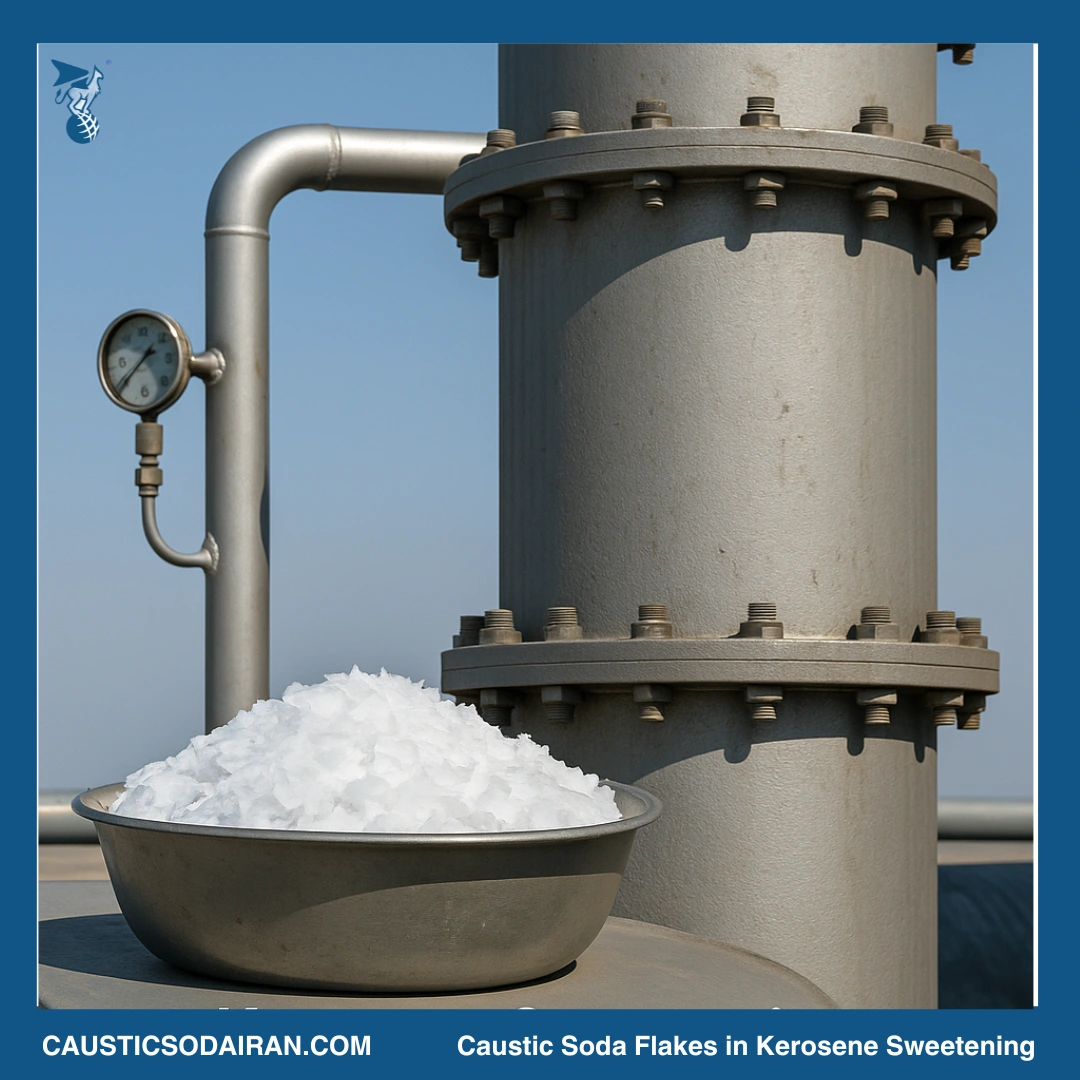
Kerosene, a key middle distillate in petroleum refining, often contains mercaptans—sulfur-based compounds that cause foul odor, corrosion, and environmental concerns. To meet international fuel standards such as Jet A-1 or Ultra Low Sulfur Kerosene (ULSK), these impurities must be neutralized. One of the most effective and economical methods is kerosene sweetening, where caustic soda flakes (solid sodium hydroxide) play a central role.
What Is Kerosene Sweetening?
Kerosene sweetening is a chemical refining process designed to remove or neutralize mercaptans, which are organic sulfur compounds naturally present in kerosene fractions of crude oil. Mercaptans are highly odorous, corrosive, and thermally unstable. If not treated, they not only reduce the fuel’s market value but also pose compliance risks with environmental standards such as ASTM D1655 for aviation fuels and Euro V for middle distillates.
The term “sweetening” refers to the transformation of these “sour” sulfur compounds into less reactive, non-odorous compounds—primarily disulfides—thus improving the fuel’s performance, storability, and smell.
Role of Caustic Soda Flakes in the Sweetening Process
Caustic soda flakes, when dissolved in water to create a strong alkaline solution (typically 10–20% NaOH), serve as an essential component in the oxidative sweetening of kerosene, often implemented within a Merox or similar fixed-bed reactor unit.
Here’s how the flakes function within the process:
1. Pre-Treatment (Neutralization)
Before entering the catalytic reactor, the kerosene is contacted with an aqueous solution of caustic soda to neutralize weak organic acids (like naphthenic acids) that could inhibit the oxidation of mercaptans. This stage conditions the kerosene and improves catalyst performance.
2. Catalytic Oxidation
In the presence of oxygen (air) and a proprietary catalyst (e.g., cobalt or vanadium-based), the sodium hydroxide reacts with mercaptans to form sodium mercaptide, which then undergoes oxidation to yield disulfides. These disulfides remain dissolved in the kerosene and are non-corrosive.
R–SH+NaOH→R–S−Na++H2OR–SH + NaOH \rightarrow R–S⁻Na⁺ + H₂O
2R–S−Na++½O2+H2O→R–S–S–R+2NaOH2R–S⁻Na⁺ + ½O₂ + H₂O → R–S–S–R + 2NaOH
This cyclic reaction allows for partial regeneration of NaOH, increasing process efficiency.
3. pH and Process Control
Maintaining the right pH (typically >12) is vital. Caustic soda flakes allow refineries to tailor the alkalinity of the system more accurately than pre-mixed liquid NaOH, offering better control over reactivity and dosing.
Advantages of Using Caustic Soda Flakes
- High Purity (≥98%) ensures consistent reactivity.
- Ease of Storage and Transport compared to liquid caustic soda.
- Cost-Effective for large-scale refinery operations.
- Compatible with Modular Units like Axens’ Sweetn’K™ systems.
Environmental and Operational Benefits
- Reduces SO₂ emissions by eliminating sulfur precursors.
- Improves fuel marketability by meeting Jet A-1 and ULSK specs.
- Protects downstream equipment from corrosion and fouling.
Sourcing Caustic Soda Flakes for Refining
For refineries seeking reliable supply, Iran offers a strategic advantage due to its petrochemical infrastructure and export capacity. A trusted supplier is:
CausticSodaIran.com – A specialized exporter of high-quality caustic soda flakes, offering tailored packaging, technical documentation, and global shipping from ports like Bandar Abbas.
Conclusion
In kerosene sweetening, caustic soda flakes are more than just a reagent—they’re a critical enabler of cleaner, compliant, and higher-value fuels. Their role in converting mercaptans to disulfides makes them indispensable in modern refining operations.


Leave a Reply