
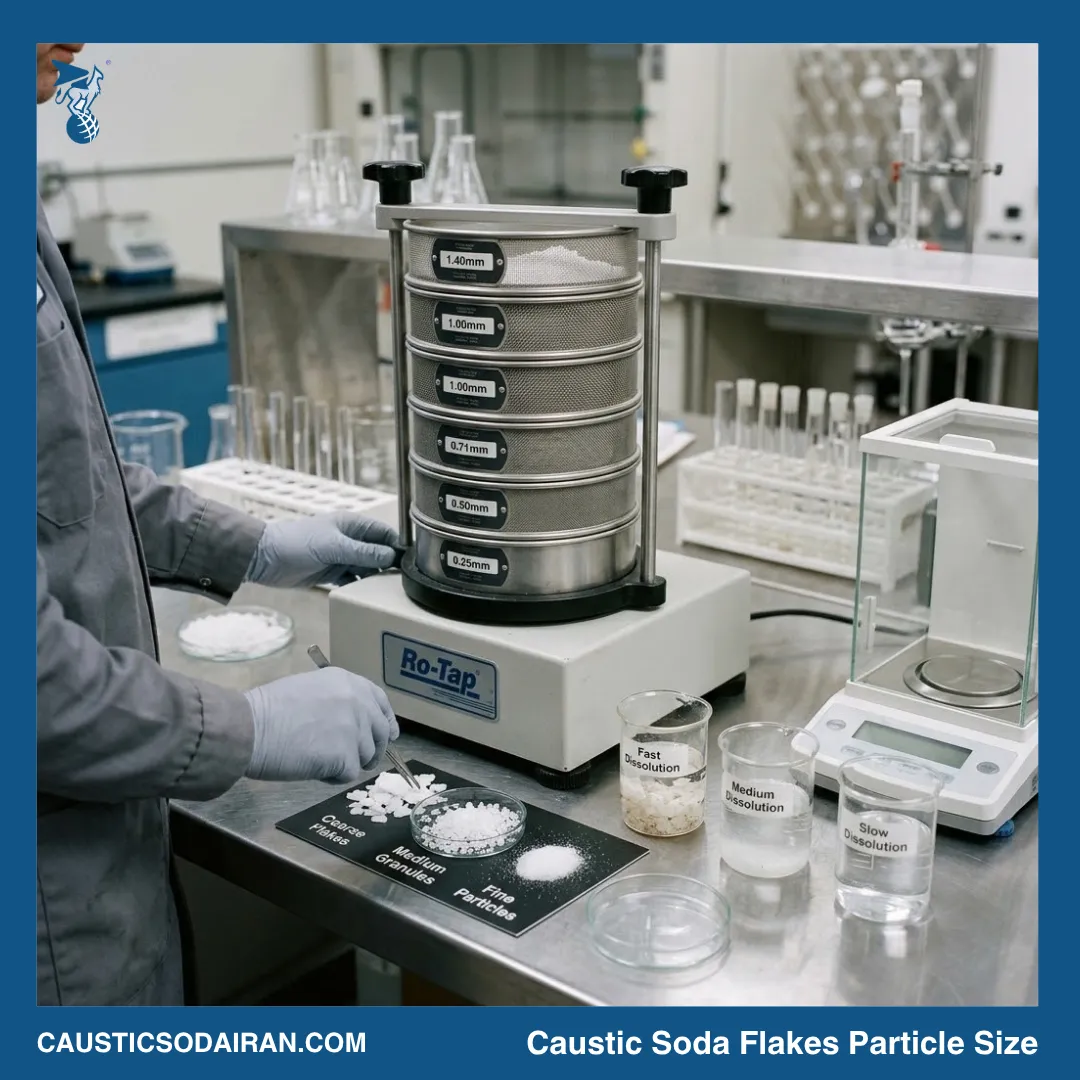
Caustic soda flakes particle size is an important factor in determining how quickly sodium hydroxide dissolves and how efficiently it performs in industrial processes. Although chemical purity remains essential, particle size distribution can also influence dissolution rate, handling, storage, and process efficiency.
Why Caustic Soda Flakes Particle Size Matters
Caustic soda flakes are solid sodium hydroxide (NaOH) supplied in flake form for applications such as chemical manufacturing, water treatment, pulp and paper production, textiles, and industrial cleaning.
The caustic soda flakes particle size affects the available surface area of the material. Smaller particles generally provide more surface area in contact with water, which can promote faster dissolution. Larger flakes, however, may be easier to handle and can generate less dust during loading and transfer.
Therefore, selecting the appropriate particle size requires balancing dissolution performance with handling requirements.
Particle Size and Dissolution Rate
Particle size directly influences the dissolution behavior of caustic soda flakes. Smaller flakes or particles typically dissolve faster because water can contact a larger surface area relative to the material volume.
This can be beneficial in processes where sodium hydroxide must be prepared quickly. However, rapid dissolution also releases significant heat because NaOH dissolution is highly exothermic.
Industrial operators should therefore control the addition rate and use suitable mixing and cooling systems when preparing concentrated caustic soda solutions. According to NIOSH, sodium hydroxide is available in flakes, beads, and granular forms, and contact with water can generate significant heat.
How Granulometry Affects Industrial Handling
Granulometry describes the particle size distribution of a solid material. For caustic soda flakes, a consistent particle size distribution can improve material handling and dosing.
Uniform flakes can provide more predictable feeding into production systems. In contrast, excessive fines may increase dust formation, while very large flakes may require additional time to dissolve.
For this reason, buyers should consider both chemical specifications and physical characteristics when selecting caustic soda flakes for industrial use.
Choosing the Right Particle Size
The ideal caustic soda flakes particle size depends on the intended application. Processes requiring rapid solution preparation may benefit from smaller and more uniform particles. Applications focused on bulk storage and mechanical handling may favor flakes with a larger and more consistent size. Understanding the differences between caustic soda flakes and pearls can also help buyers select the most suitable physical form for their process.
Other factors should also be evaluated, including:
- Sodium hydroxide purity
- Particle size distribution
- Moisture content
- Packaging requirements
- Storage conditions
- Dissolution and mixing equipment
Considering these factors together can help industrial buyers select a product that performs consistently throughout the supply chain and production process.
Conclusion
Caustic soda flakes particle size can significantly affect dissolution speed, handling, dosing, and overall process efficiency. While NaOH purity remains a critical purchasing specification, granulometry should not be overlooked when selecting caustic soda flakes for industrial applications.
Understanding the relationship between particle size and dissolution allows manufacturers to improve solution preparation, reduce handling problems, and choose a caustic soda product that better matches their operational requirements.


Leave a Reply