
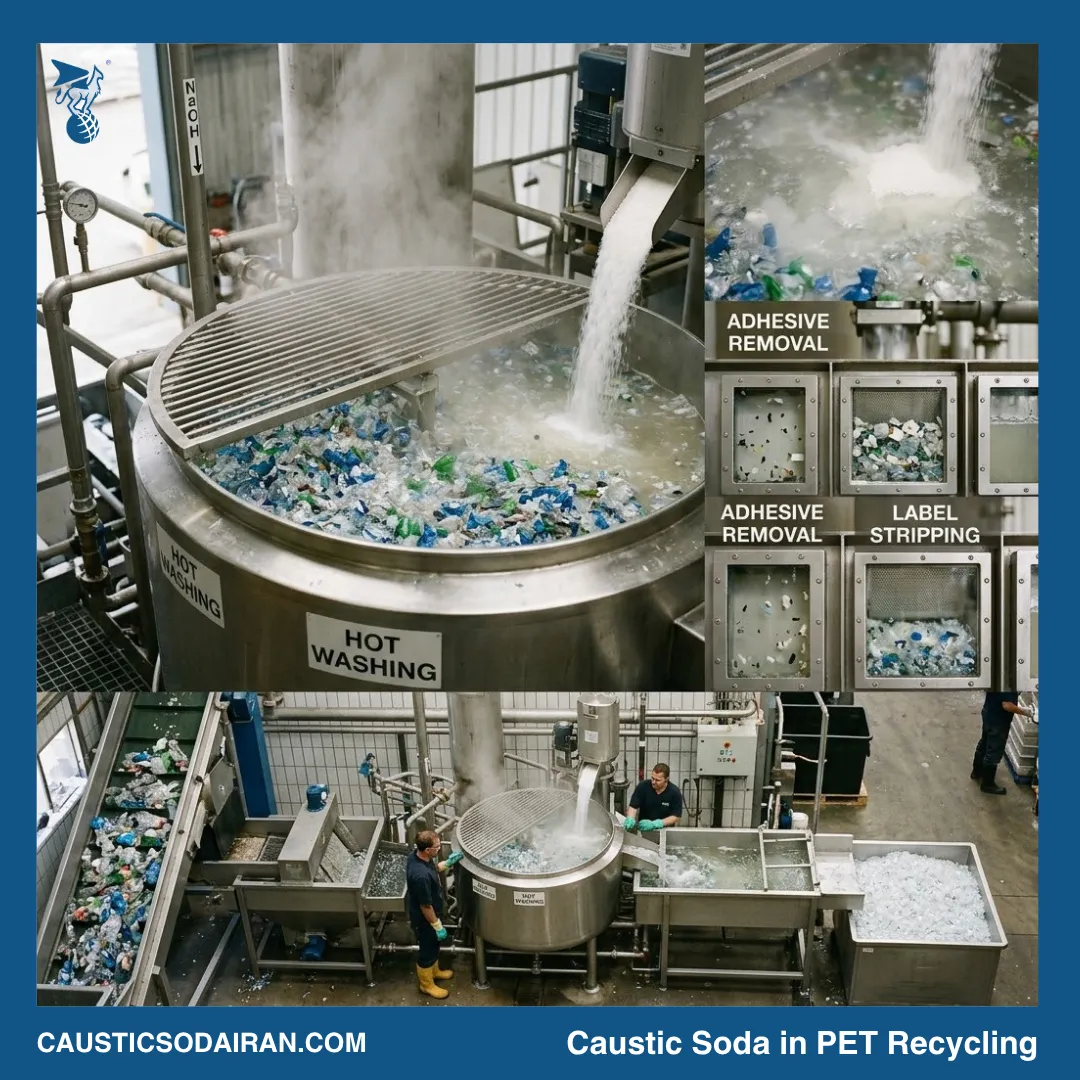
Plastic recycling depends heavily on effective cleaning and decontamination. Among the chemicals used in mechanical recycling, caustic soda in PET recycling plays an important role in removing stubborn contaminants from polyethylene terephthalate (PET) flakes.
PET bottles often contain adhesive residues, labels, oils, beverage residues, dirt, and other contaminants. Mechanical sorting and conventional water washing can remove some of these materials, but they may not be sufficient for producing high-quality recycled PET.
This is where sodium hydroxide, commonly known as caustic soda or NaOH, becomes valuable. In industrial PET recycling, hot alkaline washing combines elevated temperature, controlled caustic soda concentration, detergents, and mechanical agitation to improve the cleanliness of recycled PET flakes. European PET recycling protocols also describe hot washing using caustic soda and detergents as part of multi-stage washing processes.
What Is the Role of Caustic Soda in PET Recycling?
The main role of caustic soda in PET recycling is to improve surface cleaning and remove contaminants that remain attached to PET flakes after sorting and grinding.
Caustic soda creates an alkaline washing environment. When combined with heat and mechanical agitation, this environment helps loosen residues from the PET surface.
The process can help remove:
- Label adhesives
- Organic residues
- Oils and grease
- Dirt and surface contaminants
- Paper and label residues
- Certain metallic residues
- Other substances attached to PET flakes
However, caustic soda should not be considered a universal solution for every contaminant. Sorting remains essential because materials such as PVC, PP, HDPE, metals, and other polymers must be separated before or during the recycling process.
A typical PET recycling line may therefore include sorting, grinding, washing, density separation, hot caustic washing, rinsing, drying, and final flake sorting.
Why Is Hot Washing Important for PET Recycling?
Cold washing mainly relies on water and mechanical action to remove loose contaminants. Hot washing provides a more aggressive cleaning environment.
When the washing solution is heated, chemical reactions and contaminant removal can become more effective. Caustic soda can help break down or loosen adhesive and organic residues, while detergents improve the interaction between the washing solution and contaminants.
For this reason, industrial PET recycling commonly uses an alkaline hot-washing stage rather than relying exclusively on cold water.
Some established European protocols use temperatures around 80–85°C with controlled NaOH and detergent concentrations.
How Does the PET Hot Washing Process Work?
The hot washing stage normally takes place after PET bottles have been sorted and reduced to flakes.
1. Sorting PET Bottles
The first step is removing materials that should not enter the PET recycling stream.
Sorting may separate:
- PVC
- HDPE
- PP
- Metals
- Non-PET packaging
- Colored or unsuitable materials
- Foreign objects
Effective sorting reduces the contamination load before chemical washing.
2. Grinding and Flake Production
The bottles are then shredded or granulated into smaller PET flakes.
Smaller flakes provide greater surface area for contact with the washing solution. This allows caustic soda and detergents to interact more effectively with surface contamination.
Wet grinding can also contribute to preliminary cleaning by helping remove loose dirt and residues.
3. Hot Caustic Washing
This is the central stage where caustic soda in PET recycling provides its primary benefit.
PET flakes are introduced into a heated alkaline solution. Mechanical agitation keeps the flakes moving and increases contact between the PET surface and the washing solution.
Industrial and evaluation protocols demonstrate the use of approximately 1% NaOH with detergent at around 80–85°C under controlled mixing conditions. Other recycling systems may use different concentrations and operating parameters depending on equipment, contamination levels, and product specifications.
4. Separation and Rinsing
After hot washing, the PET flakes must be separated from the spent washing solution.
Multiple rinsing stages are important because they remove:
- Remaining caustic soda
- Dissolved contaminants
- Detergent residues
- Loose particles
Effective rinsing helps bring the PET surface closer to a neutral condition before drying and further processing.
5. Drying
After rinsing, mechanical dewatering and thermal drying reduce the remaining moisture.
The dried flakes can then proceed to further processing, such as extrusion, pelletizing, or additional decontamination depending on the intended recycled PET application.
How Caustic Soda Removes PET Contaminants
The effectiveness of caustic soda in PET recycling comes from the interaction between alkaline chemistry, temperature, mechanical agitation, and the contaminants present on the PET surface.
Adhesives and organic residues can become difficult to remove when they have remained on bottles for extended periods. A heated alkaline bath can help loosen these materials and improve their separation from PET flakes.
Caustic washing can therefore create a significantly cleaner flake surface than simple water washing in many recycling applications.
Research on PET mechanical recycling has also investigated alkaline chemical washing as a surface-cleaning treatment, showing that sodium hydroxide can remove contaminated surface material while leaving the core of the PET particle relatively unaffected under the tested conditions.
Caustic Soda and Label Adhesive Removal
Label adhesives are among the important contaminants encountered during PET bottle recycling.
If adhesive residues remain on PET flakes, they can create quality problems during subsequent processing. Hot alkaline washing helps weaken and remove these residues from the PET surface.
The effectiveness depends on several variables, including:
- NaOH concentration
- Washing temperature
- Residence time
- Agitation intensity
- Detergent selection
- Type of adhesive
- Contamination level
- PET flake size
Therefore, simply increasing caustic soda concentration is not always the best solution. The entire washing system must be optimized.
Temperature and Caustic Soda Concentration
Temperature and chemical concentration are two critical variables in PET hot washing.
A higher temperature can accelerate cleaning reactions, but excessive chemical severity may negatively affect PET quality. Likewise, excessive NaOH concentration can increase chemical consumption, wastewater treatment requirements, and the risk of undesirable surface reactions.
For example, European PET recycling protocols describe controlled hot-washing conditions rather than simply maximizing temperature or chemical concentration. One protocol specifies a 1 wt% NaOH solution with detergent at 85°C, while other recyclability protocols use different controlled conditions.
Therefore, recycling plants should determine operating conditions according to:
- PET quality requirements
- Contamination level
- Washing equipment
- Residence time
- Agitation conditions
- Detergent formulation
- Rinsing capacity
- Wastewater treatment system
Benefits of Caustic Soda in PET Recycling
Using caustic soda in a properly designed PET washing system can provide several benefits.
Improved Surface Cleanliness
Hot alkaline washing can remove difficult surface residues that may remain after mechanical sorting and water washing.
Better Adhesive Removal
Caustic solutions combined with heat and detergents can help detach label adhesives from PET flakes.
Higher Recycled PET Quality
Cleaner flakes provide a better feedstock for downstream recycling operations. This is particularly important when recycled PET is intended for demanding applications.
Reduced Contamination
Removing organic and surface contaminants can improve the consistency of the recycled material.
Compatibility With Industrial Recycling Lines
Caustic washing is already integrated into established PET recycling processes. EFSA assessments of several recycled-PET technologies describe hot caustic-washed and dried PET flakes as an input to subsequent decontamination and recycling stages.
Challenges of Caustic Soda Hot Washing
Despite its benefits, caustic soda hot washing requires careful process control.
PET Surface Damage
Excessive alkaline treatment can affect the PET surface. The objective is to remove contamination without unnecessarily attacking the polymer.
Chemical Consumption
NaOH must be replenished or managed as its concentration changes during operation.
Wastewater Generation
Hot washing produces wastewater containing alkaline compounds, detergents, dissolved contaminants, and suspended solids.
This wastewater requires appropriate treatment before discharge or reuse.
Energy Consumption
Heating large volumes of washing water requires significant energy. Efficient heat recovery and process optimization can reduce operating costs.
Need for Effective Rinsing
Residual caustic soda must be removed from the flakes before they enter subsequent processing stages.
Wastewater Management and Caustic Soda Recovery
One of the major sustainability challenges associated with PET hot washing is wastewater management. Effective caustic soda in wastewater treatment can help control alkaline conditions and manage industrial effluents generated during chemical washing processes.
PET recycling wastewater can contain alkaline compounds and contaminants removed from the flakes. Consequently, treatment is required before reuse or discharge.
Recent research has also investigated membrane-based treatment methods for recovering NaOH from PET washing wastewater. One study reported NaOH recovery of up to 98.6% under its tested membrane-filtration conditions, demonstrating the potential for chemical recovery and water-treatment strategies in recycling operations.
This approach can potentially reduce:
- Fresh caustic soda consumption
- Wastewater volume
- Chemical losses
- Operating costs
- Environmental impact
However, actual recovery performance depends on wastewater composition and the treatment technology used.
How to Optimize Caustic Soda in PET Recycling
A successful hot-washing system requires more than selecting an appropriate chemical.
Recycling operators should monitor the complete process.
Control NaOH Concentration
The concentration should remain within the operating range established for the specific recycling line.
Maintain Consistent Temperature
Temperature fluctuations can change cleaning performance and chemical efficiency.
Optimize Residence Time
Longer washing does not automatically mean better results. Excessive treatment can increase energy and chemical consumption.
Use Appropriate Detergents
Detergents can improve contaminant removal and complement the alkaline action of NaOH.
Optimize Mechanical Agitation
Agitation increases contact between PET flakes and the washing solution. European testing protocols specifically control mixing conditions during hot washing.
Improve Rinsing
Efficient rinsing is essential for removing residual chemicals before drying.
Monitor PET Flake Quality
Important quality parameters may include:
- Color
- Moisture
- Intrinsic viscosity
- Bulk density
- Black spots
- Fine-particle content
- PVC contamination
- Metal contamination
Caustic Soda vs. Conventional Water Washing
The main difference between hot caustic washing and conventional water washing is the chemical environment.
| Feature | Water Washing | Hot Caustic Washing |
|---|---|---|
| Main medium | Water | Alkaline water |
| NaOH | Not required | Used |
| Temperature | Often lower | Typically elevated |
| Adhesive removal | Limited to moderate | Generally stronger |
| Organic residue removal | Moderate | Improved |
| Chemical control | Simpler | More demanding |
| Wastewater treatment | Required | More complex |
| Process cost | Lower | Higher but potentially better cleaning |
The choice depends on the quality requirements of the recycled PET and the level of contamination in the incoming material.
Is Caustic Soda Essential for High-Quality PET Recycling?
Caustic soda is not the only factor determining recycled PET quality. High-quality recycling requires an integrated process.
Sorting, grinding, washing, density separation, rinsing, drying, filtration, and decontamination all contribute to the final product.
However, caustic soda in PET recycling can be an important component of the washing stage because it helps address contaminants that mechanical separation alone cannot effectively remove.
For applications requiring particularly high purity, additional decontamination technologies may be necessary after hot washing. EFSA assessments show that hot caustic washing can serve as an upstream step before additional high-temperature or vacuum-based decontamination processes.
Conclusion
The role of caustic soda in PET recycling extends beyond simple cleaning. When properly controlled, sodium hydroxide helps create an effective alkaline environment for hot washing, improving the removal of adhesives, oils, organic residues, labels, and other surface contaminants from PET flakes.
The best results come from balancing NaOH concentration, temperature, residence time, agitation, detergent selection, rinsing, and wastewater management.
As PET recycling continues to focus on higher-quality recycled materials, optimized hot-washing systems can play an important role in producing cleaner and more consistent PET feedstock for downstream processing.
For industrial recyclers, the goal should not be to use the maximum amount of caustic soda. Instead, the objective is to achieve the required level of PET cleanliness with controlled chemical consumption, efficient energy use, and responsible wastewater management.
Leave a Reply