
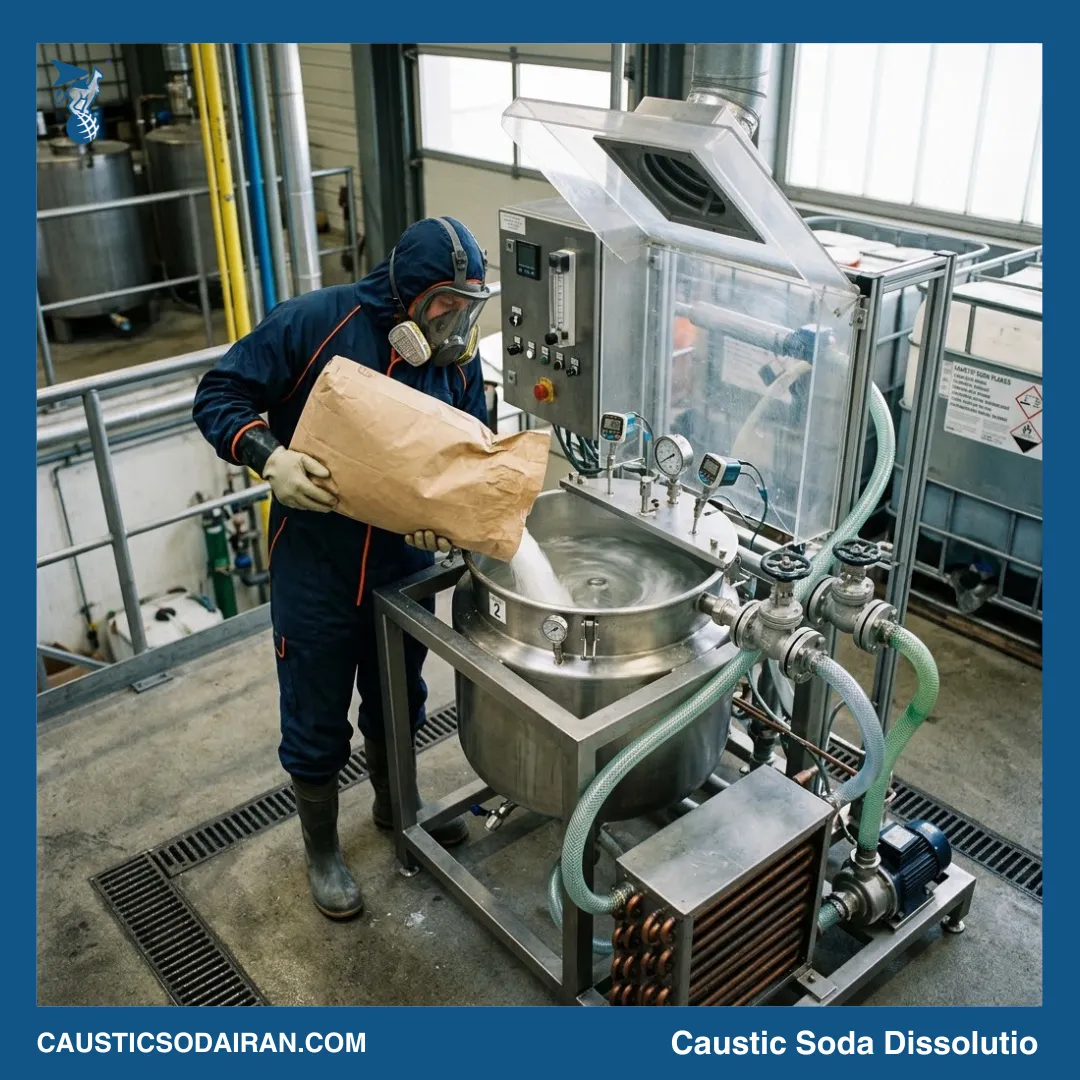
Caustic soda dissolution requires careful process control because sodium hydroxide (NaOH) releases a substantial amount of heat when it dissolves in water. Industries use caustic soda flakes in chemical processing, water treatment, detergents, pulp and paper production, and many other applications. However, improper handling can cause severe burns, splashing, local boiling, and equipment damage.
A controlled dissolution process combines the correct addition sequence, effective agitation, temperature monitoring, suitable materials, and appropriate personal protective equipment. This guide explains how industrial operators can approach caustic soda flake dissolution safely while maintaining control over the exothermic reaction.
Why Is Caustic Soda Dissolution Exothermic?
Sodium hydroxide dissolves readily in water and releases heat during the process. The heat can raise the solution temperature rapidly, especially when operators add a large quantity of solid NaOH too quickly.
The released heat can cause local boiling and splashing when the system cannot distribute or remove the heat fast enough. PubChem also notes that dilution with water can generate enough heat to cause local boiling and splattering.
Therefore, operators must control three critical variables:
- NaOH addition rate
- Mixing intensity
- Temperature and heat removal
A well-designed system manages these variables together instead of relying on manual observation alone.
Step 1: Review the SDS and Process Procedure
Before starting the dissolution process, review the current Safety Data Sheet (SDS) for the specific caustic soda product.
The operating procedure should clearly define:
- Required NaOH concentration
- Water quantity
- Maximum operating temperature
- Addition sequence
- Addition rate
- Agitation requirements
- Cooling requirements
- Equipment materials
- Emergency procedures
- Required PPE
Operators should also understand the hazards associated with sodium hydroxide. NIOSH classifies sodium hydroxide as a corrosive substance that can cause serious skin and eye damage.
For industrial operations, the process engineer should establish the exact operating limits. A generic procedure cannot replace a site-specific risk assessment.
Step 2: Select Compatible Dissolution Equipment
Equipment selection plays a major role in safe caustic soda dissolution.
The process can expose tanks, pipes, pumps, valves, seals, and instruments to both corrosive NaOH and elevated temperatures. Engineers should therefore evaluate material compatibility at the actual concentration and temperature of the solution.
Potential materials include:
- Carbon steel for suitable controlled conditions
- Stainless steel for selected applications
- Nickel alloys for demanding caustic service
- Polypropylene (PP)
- PVC
- Suitable corrosion-resistant linings
The correct material depends on concentration, temperature, residence time, mechanical conditions, and other process variables.
Operators should pay particular attention to incompatible metals. Sodium hydroxide can attack metals such as aluminum, tin, and zinc. These reactions can also generate hydrogen gas. NIOSH identifies aluminum, tin, and zinc among sodium hydroxide incompatibilities.
Step 3: Charge Water Into the Mixing Vessel
Start the process by adding the required water to the dissolution vessel.
This sequence matters.
Add caustic soda flakes to water. Never add water onto a concentrated mass of caustic soda.
When water contacts a concentrated quantity of NaOH, the reaction can release heat very quickly in a small area. That localized heat can trigger boiling and splashing.
A sodium hydroxide preparation SOP from Science ASSIST also specifies the same sequence: operators should add solid sodium hydroxide to water rather than adding water to solid sodium hydroxide.
The plant’s operating procedure should determine the starting water temperature and target concentration.
Step 4: Start the Agitation System
Start the agitator before introducing the caustic soda flakes.
Effective agitation helps distribute the incoming material throughout the water and spreads the generated heat through the bulk solution.
A suitable mixing system should provide:
- Consistent circulation
- Adequate turnover of the liquid
- Minimal dead zones
- Controlled material dispersion
- Efficient heat distribution
Poor mixing can create a concentrated zone around the addition point. That zone may reach a much higher temperature than the average vessel temperature.
For this reason, operators should never rely on a single temperature reading without considering the mixing pattern.
Step 5: Add Caustic Soda Flakes Gradually
Once the water and agitation system reach the required starting conditions, begin adding the caustic soda flakes gradually.
Avoid dumping a large quantity into the vessel at once.
A controlled addition rate gives the water and cooling system time to absorb and distribute the released heat. The appropriate rate depends on the specific equipment and process design.
Engineers should consider:
- Vessel volume
- Water-to-NaOH ratio
- Target concentration
- Cooling capacity
- Agitator performance
- Maximum allowable temperature
- Feeder capacity
Industrial systems can use controlled solids feeders to maintain a consistent addition rate. Smaller systems may use manual addition, but operators still need to follow the validated procedure and avoid rapid charging.
Step 6: Monitor Temperature During Dissolution
Temperature monitoring provides one of the most important controls during the process.
As the flakes dissolve, the solution temperature can increase rapidly. Operators should monitor the temperature continuously and compare it with the predefined operating limit.
Industrial systems may use:
- Temperature sensors
- Local temperature indicators
- High-temperature alarms
- Automatic feed interruption
- Cooling-water control
- Process interlocks
The system should give operators enough time to slow or stop the NaOH feed if the temperature approaches the established limit.
The National Institute for Standards and Technology also warns that sodium hydroxide dissolution in water produces significant heat and recommends slow addition with cooling during dissolution.
Step 7: Control the Exothermic Reaction
Effective exothermic reaction control combines several engineering measures.
Control the Feed Rate
A controlled feed limits the amount of NaOH that enters the vessel at one time.
If the temperature rises too quickly, operators should reduce or stop the feed according to the plant’s emergency or operating procedure.
Maintain Effective Mixing
Agitation distributes both NaOH and heat throughout the solution.
The agitator should provide sufficient circulation without creating excessive splashing.
Provide Cooling Capacity
Large-scale dissolution systems may require a cooling jacket or external heat exchanger.
Engineers should size the cooling system according to the maximum expected heat release and operating conditions.
Use Temperature Alarms
A high-temperature alarm can alert operators before the process reaches a critical condition.
Automated systems can also interrupt the NaOH feed when the temperature reaches a predefined safety limit.
Maintain Adequate Freeboard
The vessel should provide sufficient freeboard for thermal expansion, agitation, and unexpected splashing.
The design should account for the maximum operating volume rather than the normal operating volume alone.
Step 8: Use the Correct PPE
Sodium hydroxide can cause severe chemical burns and serious eye damage. For additional guidance on workplace protection, PPE, and emergency response, see our guide to [caustic soda safety protocols and first-aid response]. NIOSH recommends preventing skin and eye contact and providing appropriate emergency washing facilities.
The site risk assessment should define the required PPE. Depending on the operation, workers may need:
- Chemical-resistant gloves
- Chemical safety goggles
- Face shield
- Chemical-resistant apron
- Protective clothing
- Chemical-resistant safety boots
- Respiratory protection when the exposure assessment requires it
The Canadian Centre for Occupational Health and Safety recommends chemical safety goggles and suitable chemical-protective gloves, clothing, and boots for sodium hydroxide work.
Workers should also have immediate access to an eyewash station and emergency shower.
PPE should support engineering controls rather than replace them.
Step 9: Check the Final Solution
After the flakes dissolve completely, allow the process to reach the specified stable condition.
Operators can then check the parameters required by the production specification.
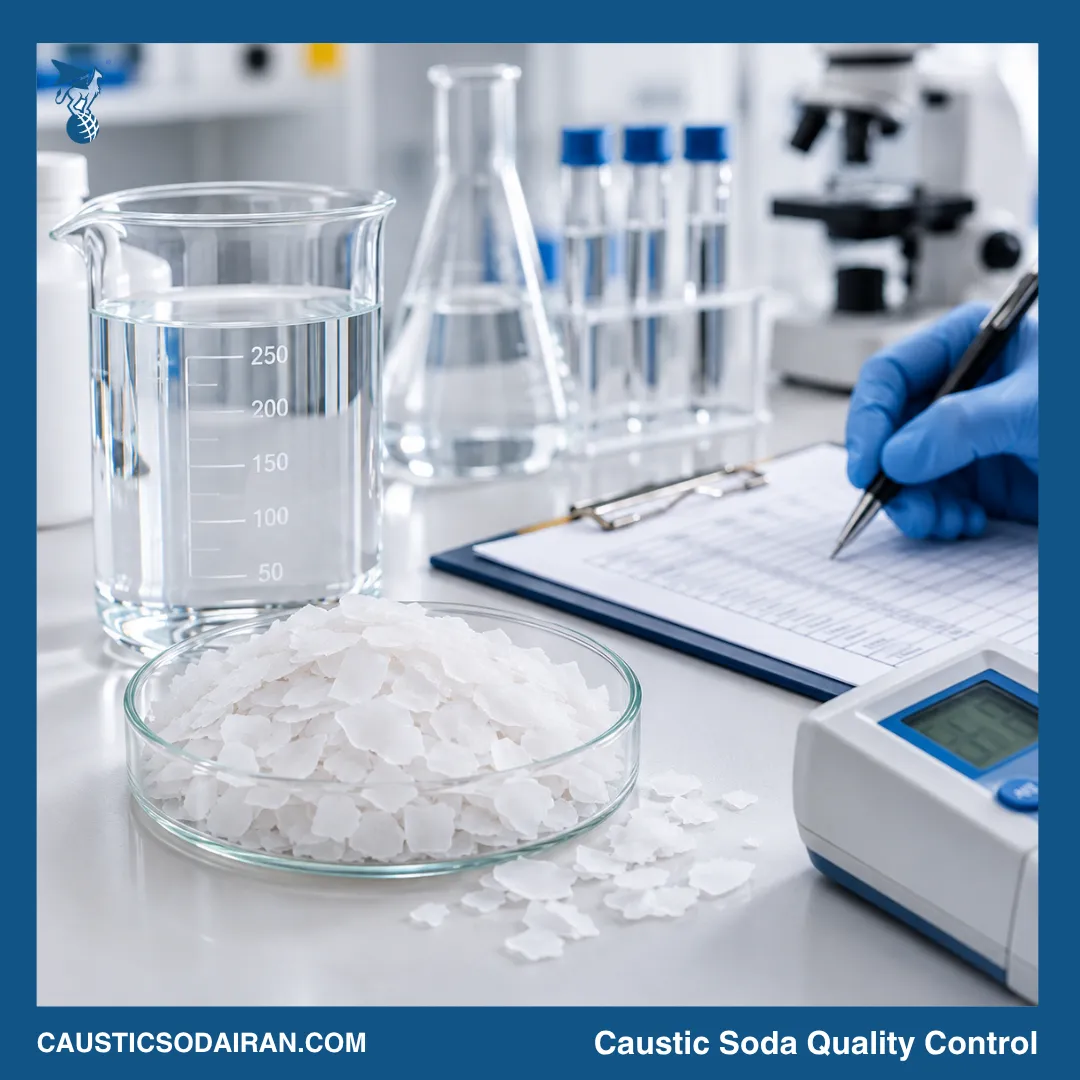
Depending on the application, quality control may measure:
- NaOH concentration
- Solution temperature
- Specific gravity
- pH
- Visual appearance
- Presence of undissolved solids
The production team should verify the final concentration before transferring the solution to another process stage.
Concentration control becomes particularly important when the plant prepares high-strength NaOH solutions because temperature changes can affect handling, storage, and crystallization behavior.
Equipment Standards for Safe Caustic Soda Dissolution
A reliable dissolution system should address chemical compatibility, heat management, mixing, instrumentation, and operator protection.
Mixing Tank
The tank should tolerate the intended NaOH concentration and operating temperature.
Engineers should evaluate:
- Construction material
- Corrosion resistance
- Mechanical strength
- Operating volume
- Freeboard
- Heat transfer requirements
Agitator
The agitator should distribute the flakes and heat effectively.
Engineers should select the impeller, shaft, seals, and motor according to the solution properties and operating conditions.
Cooling System
Industrial systems may need a jacketed tank or external cooling loop.
The cooling system should provide enough capacity to control the heat generated during the maximum planned addition rate.
Piping and Valves
Piping systems should use materials that can tolerate the actual NaOH concentration and temperature.
Engineers should evaluate:
- Pipes
- Valves
- Gaskets
- Mechanical seals
- Pump components
- Instrument connections
Do not select these components solely because a material appears generally corrosion-resistant.
Temperature Instrumentation
Install suitable temperature sensors at locations that provide useful process information.
For additional workplace safety information, visit the official OSHA
Large systems may also require:
- High-temperature alarms
- Automatic shutdown
- Feed interlocks
- Temperature recording
- Control-system integration
Ventilation
The facility should provide suitable ventilation when the process can generate caustic dust, mist, or aerosols.
CCOHS recommends local exhaust ventilation or process enclosure when necessary to control sodium hydroxide exposure.
Common Caustic Soda Dissolution Mistakes
Operators can avoid many incidents by controlling a few common errors.
Adding Water to Solid NaOH
Never pour water onto a concentrated quantity of caustic soda.
Instead, charge water first and add NaOH gradually. This approach reduces the risk of localized overheating and splashing.
Adding Flakes Too Quickly
Rapid addition can overwhelm the mixing and cooling capacity.
Control the feed rate according to the validated process procedure.
Starting Without Agitation
Start the agitator before adding the flakes.
Without sufficient mixing, the process can create localized high-temperature zones.
Ignoring Temperature Changes
Do not judge process safety from appearance alone.
Monitor temperature throughout the dissolution stage and respond to abnormal temperature increases immediately.
Selecting Incompatible Materials
Avoid materials that can react with concentrated sodium hydroxide.
For example, sodium hydroxide can corrode metals such as aluminum, tin, and zinc and may generate hydrogen during certain metal reactions.
Relying Only on PPE
Gloves and goggles cannot control an exothermic reaction.
Use engineering controls such as controlled feeding, agitation, temperature monitoring, cooling, and appropriate containment.
Caustic Soda Dissolution Safety Checklist
Before starting the process, operators should verify the following:
- The current SDS is available.
- The plant procedure defines the target concentration.
- The water quantity meets the process specification.
- The agitator works correctly.
- Temperature instrumentation works correctly.
- The cooling system can handle the expected heat load.
- The NaOH feed system allows controlled addition.
- The vessel uses compatible materials.
- The piping system uses suitable components.
- Required PPE is available and properly fitted.
- Emergency eyewash facilities remain accessible.
- The emergency shower remains accessible.
- Operators understand the shutdown procedure.
- The process has adequate ventilation.
Conclusion
Safe caustic soda dissolution requires disciplined control of the material addition rate, mixing, temperature, cooling, and equipment compatibility.
The most important principle remains straightforward: add caustic soda flakes gradually to water while maintaining effective agitation and controlling the heat generated by dissolution.
Industrial facilities should also select equipment according to the actual NaOH concentration and operating temperature. Proper temperature instrumentation, cooling capacity, compatible materials, ventilation, and PPE can further reduce the risk of burns, splashing, corrosion, and uncontrolled temperature increases.
Before implementing any dissolution procedure, operators should follow the current SDS, site-specific risk assessment, and approved engineering procedures. A properly designed process protects both personnel and equipment while providing consistent caustic soda solution quality.
Leave a Reply