
What Is Chlor-Alkali Technology?
The chlor-alkali process is an electrochemical method used to manufacture three major industrial chemicals:
- Caustic soda (sodium hydroxide)
- Chlorine
- Hydrogen
In the process, purified brine is electrolyzed inside an electrolytic cell. The design of the cell determines how sodium ions, chloride ions, hydroxide ions, chlorine, and hydrogen are separated.
Historically, chlor-alkali plants have used three major cell technologies: mercury cells, diaphragm cells, and membrane cells. Today, membrane technology has become increasingly important because it offers strong performance in energy efficiency and caustic soda quality.
How Diaphragm Cell Technology Works
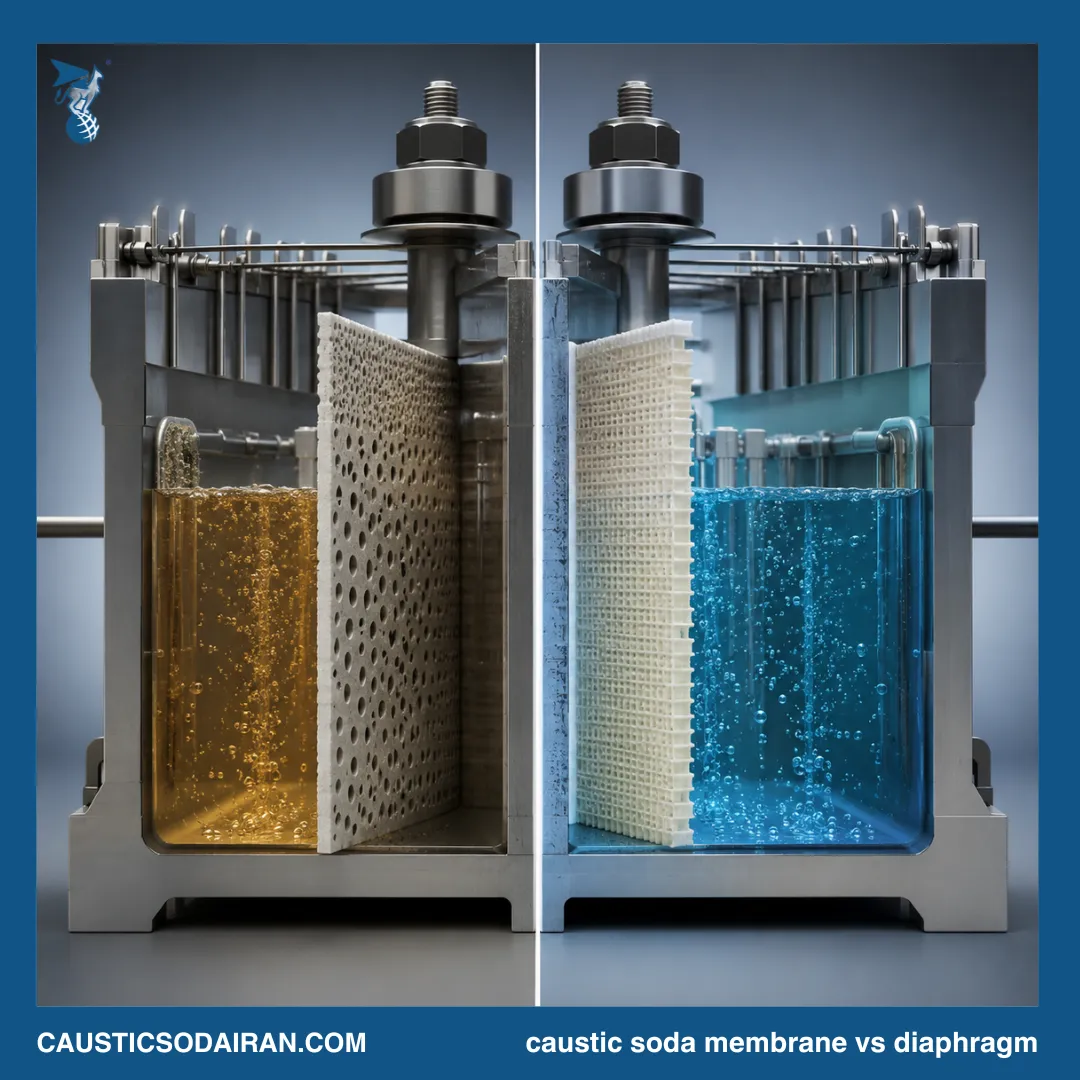
A diaphragm cell separates the anode and cathode compartments using a porous diaphragm. Brine enters the anode compartment, where chloride ions are oxidized to produce chlorine.
Sodium ions migrate through the diaphragm toward the cathode compartment. At the cathode, water is reduced and produces hydrogen and hydroxide ions.
The sodium ions and hydroxide ions combine to form sodium hydroxide.
However, the porous structure of the diaphragm allows some mixing between the two compartments. As a result, the caustic soda solution leaving the cell contains a relatively higher concentration of sodium chloride.
This characteristic creates an important quality difference between diaphragm-cell caustic soda and membrane-cell caustic soda.
How Membrane Cell Technology Works
Membrane cells use a selective ion-exchange membrane between the anode and cathode compartments.
The membrane allows sodium ions to pass from the anode side toward the cathode side while significantly restricting the movement of chloride ions and hydroxide ions in the opposite direction.
This controlled separation improves the purity of the resulting sodium hydroxide solution.
The process can therefore produce caustic soda with substantially lower sodium chloride contamination than conventional diaphragm technology. The fundamentals of chlor-alkali cell separators and membrane and diaphragm materials are discussed in detail in the technical literature.
Membrane vs. Diaphragm: Key Technical Differences
The main differences between the two technologies involve product purity, energy efficiency, brine requirements, and downstream processing.
| Factor | Membrane Technology | Diaphragm Technology |
|---|---|---|
| Caustic soda purity | Higher | Lower |
| NaCl contamination | Lower | Higher |
| Energy efficiency | Generally better | Generally lower |
| Brine purity requirement | Higher | Lower |
| Caustic concentration from cell | Higher | Lower |
| Evaporation requirement | Lower | Higher |
| Modern plant adoption | High | Established but declining in many applications |
| Process complexity | Higher membrane sensitivity | Relatively robust |
These differences are particularly important when caustic soda is intended for applications that require consistent chemical specifications.
1. Caustic Soda Purity
One of the biggest differences in caustic soda membrane vs diaphragm production is product purity.
Because membrane cells provide stronger separation between the anode and cathode compartments, less sodium chloride reaches the caustic soda stream.
Diaphragm cells, in contrast, allow greater migration of brine components through the porous diaphragm. Consequently, the resulting caustic soda solution typically contains more sodium chloride.
For industrial applications where chloride contamination can affect downstream reactions, membrane-cell caustic soda can therefore provide an important quality advantage.
2. Energy Consumption
Energy efficiency is another major consideration. Diaphragm cells typically produce a more dilute caustic soda solution. Additional evaporation is therefore required to reach commercial concentrations, which can increase energy consumption.
Membrane cells can operate with lower voltage requirements under suitable operating conditions and generally require less energy for downstream concentration of the caustic soda solution.
Diaphragm cells typically produce a more dilute caustic soda solution. Additional evaporation is therefore required to reach commercial concentrations.
This additional evaporation increases steam and energy requirements.
As a result, membrane technology can offer a more attractive energy profile for modern chlor-alkali plants.
3. Caustic Soda Concentration
The concentration of sodium hydroxide leaving the electrolytic cell is another important difference.
Membrane cells can produce a relatively concentrated caustic soda solution directly from the electrolysis stage. The solution is then concentrated further if a higher commercial concentration is required.
Diaphragm cells generally produce a more dilute solution containing more sodium chloride.
This means that diaphragm-based plants often require more extensive evaporation and purification steps before the product reaches the desired specification.
4. Brine Quality Requirements
The advantages of membrane technology come with stricter requirements.
Ion-exchange membranes are sensitive to certain impurities in the brine feed. Calcium, magnesium, iron, and other contaminants can negatively affect membrane performance.
Therefore, membrane-cell plants normally require highly purified brine before electrolysis.
Diaphragm cells can be somewhat more tolerant of certain brine impurities. However, this operational advantage comes with the trade-off of lower caustic soda purity.
5. Operating and Maintenance Considerations
Membrane technology requires careful control of operating conditions.
Brine purification, membrane condition, pressure balance, temperature, and electrolyte concentration must be monitored closely. Contamination can reduce membrane performance and increase operating costs.
Diaphragm cells have a simpler separation principle because they use a porous diaphragm. However, the diaphragm itself is a consumable component and requires periodic replacement or maintenance.
Therefore, technology selection should consider not only energy consumption but also maintenance requirements, plant infrastructure, and feedstock quality.
6. Product Quality and Industrial Applications
The quality requirements of the final product can determine which technology is more suitable.
High-purity caustic soda is particularly valuable in applications where chloride and other impurities can interfere with manufacturing processes.
Typical industrial applications include:
- Chemical manufacturing
- Pulp and paper
- Alumina production
- Textile processing
- Water treatment
- Detergent manufacturing
- Petroleum processing
- Industrial cleaning
For demanding applications, buyers should evaluate the COA (Certificate of Analysis) rather than selecting a supplier based only on the production technology.
Important parameters can include sodium hydroxide concentration, sodium chloride content, iron, carbonate, and other relevant impurities.
Is Membrane Technology Always Better?
Not necessarily.
Membrane technology provides important advantages in purity and energy efficiency, but it also requires high-quality brine purification and careful process control.
Diaphragm technology can remain suitable for plants where existing infrastructure, feedstock characteristics, capital investment, or specific product requirements make conversion to membrane technology less attractive.
Therefore, the question is not simply whether membrane technology is better. The more useful question is whether its technical and economic advantages justify the investment for a particular plant.
Why Membrane Technology Is Increasingly Important
The modern chlor-alkali industry places greater emphasis on energy efficiency, environmental performance, and product consistency.
Membrane cells address several of these requirements simultaneously. They can reduce downstream evaporation requirements, improve caustic soda purity, and support more efficient plant operation.
For this reason, membrane technology has become an important benchmark when evaluating modern caustic soda production facilities.
What Should Industrial Buyers Check?
Technology alone does not guarantee product quality.
When purchasing caustic soda, industrial buyers should request a current COA and verify parameters such as:
- Sodium hydroxide concentration
- Sodium chloride content
- Iron concentration
- Sodium carbonate
- Appearance
- Packaging specification
- Production date
- Batch number
For bulk procurement, buyers should also evaluate the supplier’s consistency across multiple shipments rather than relying on a single laboratory result.
Final Comparison: Membrane vs. Diaphragm Technology
The comparison between membrane vs. diaphragm technology demonstrates why cell design matters in caustic soda manufacturing.
Membrane technology generally provides higher product purity, lower chloride contamination, better energy efficiency, and lower downstream evaporation requirements. However, it requires better brine purification and more precise process control.
Diaphragm technology remains a technically established option and can offer advantages in terms of feedstock tolerance and existing plant infrastructure. Its main limitations are typically higher salt contamination and greater energy requirements for concentrating the caustic soda solution.
For modern industrial production, membrane technology is often preferred when high purity, energy efficiency, and consistent product specifications are key priorities.
For reliable industrial-grade caustic soda supply, working with an experienced supplier and reviewing the product COA before procurement are essential steps for maintaining consistent quality and process performance.
Leave a Reply